
Why Vans & Fleet Vehicles Suffer More DPF Problems
Fleet DPF cleaning is one of the most in-demand services we handle at Expert DPF Cleaning — and it is not hard to see why. The way vans and commercial vehicles are used day-to-day puts their diesel particulate filters under far greater stress than a typical family car ever faces. If you manage a fleet, own a single delivery van, or run a trade vehicle, understanding why this happens could save you significant downtime and expense.
What Is a DPF and Why Is It Important?
A Diesel Particulate Filter, or DPF, is a component built into the exhaust system of virtually every diesel vehicle sold in the UK since 2009. Its job is to capture soot particles produced during combustion, preventing them from being released into the atmosphere.
Over time, the filter fills up. To prevent blockage, your vehicle carries out a process called regeneration — essentially burning off accumulated soot at high exhaust temperatures, typically above 600°C. When regeneration works as intended, you never even notice it happening.
The problem is that regeneration needs specific conditions to complete successfully. It requires the engine to be properly warmed up and the vehicle to be driven at a sustained speed, usually on a dual carriageway or motorway. For fleet vehicles doing the kind of work they are typically asked to do, those conditions are rarely met.
Why Fleet Vehicles Experience More DPF Issues Than Cars
Fleet vans work harder every day. Short urban routes, repeated stopping, engine idling and failed regeneration cycles make DPF problems far more common than in normal passenger cars.
Passenger cars usually get a mix of short trips and longer motorway runs. Fleet vehicles often do the opposite. Delivery vans and trade vehicles spend most of their working day in traffic, stopping, starting and idling — creating the perfect conditions for soot build-up.
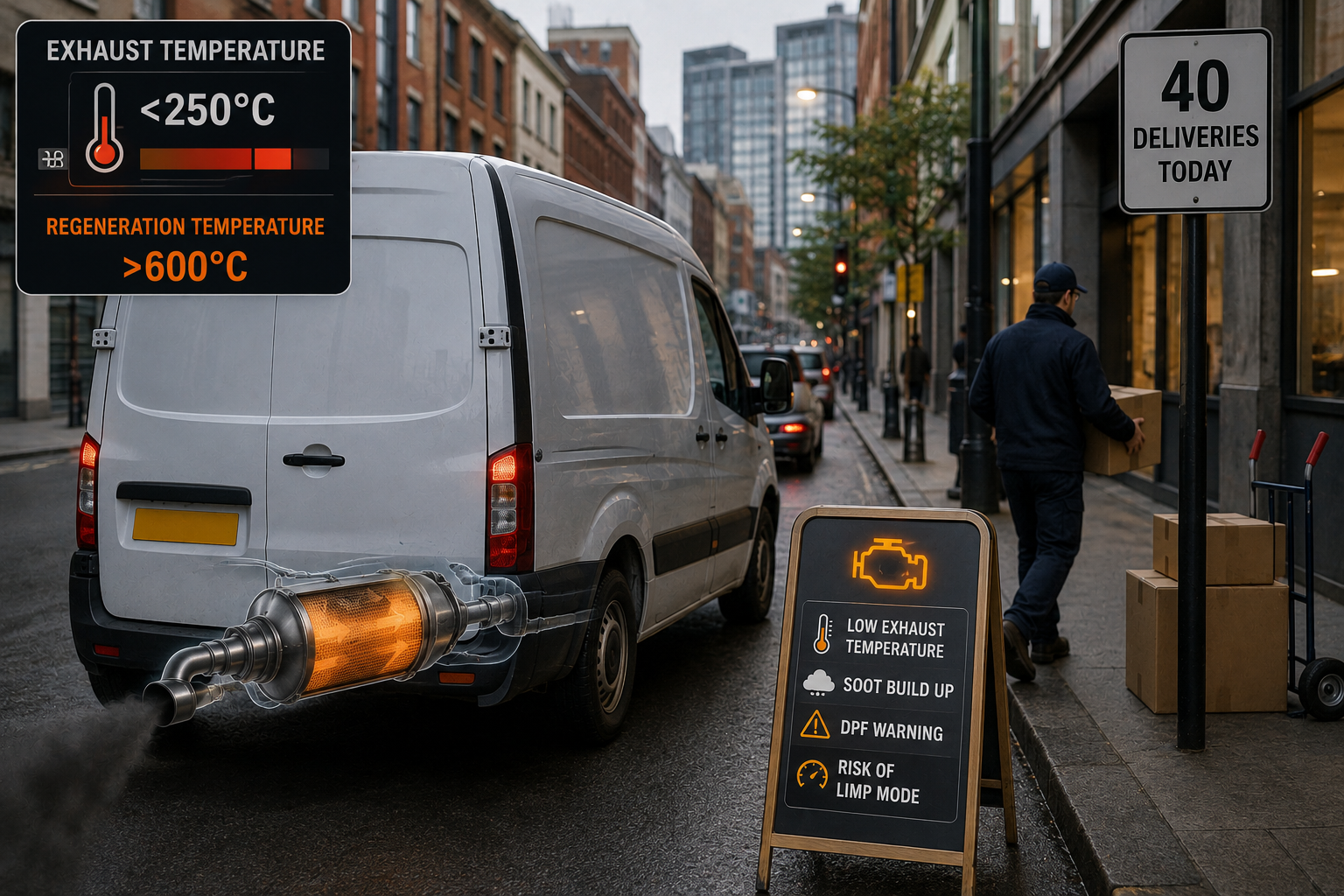
Stop-Start Urban Driving
Urban delivery routes keep exhaust temperatures too low for passive regeneration. Every short journey adds soot to the filter, eventually triggering warning lights and reduced performance.
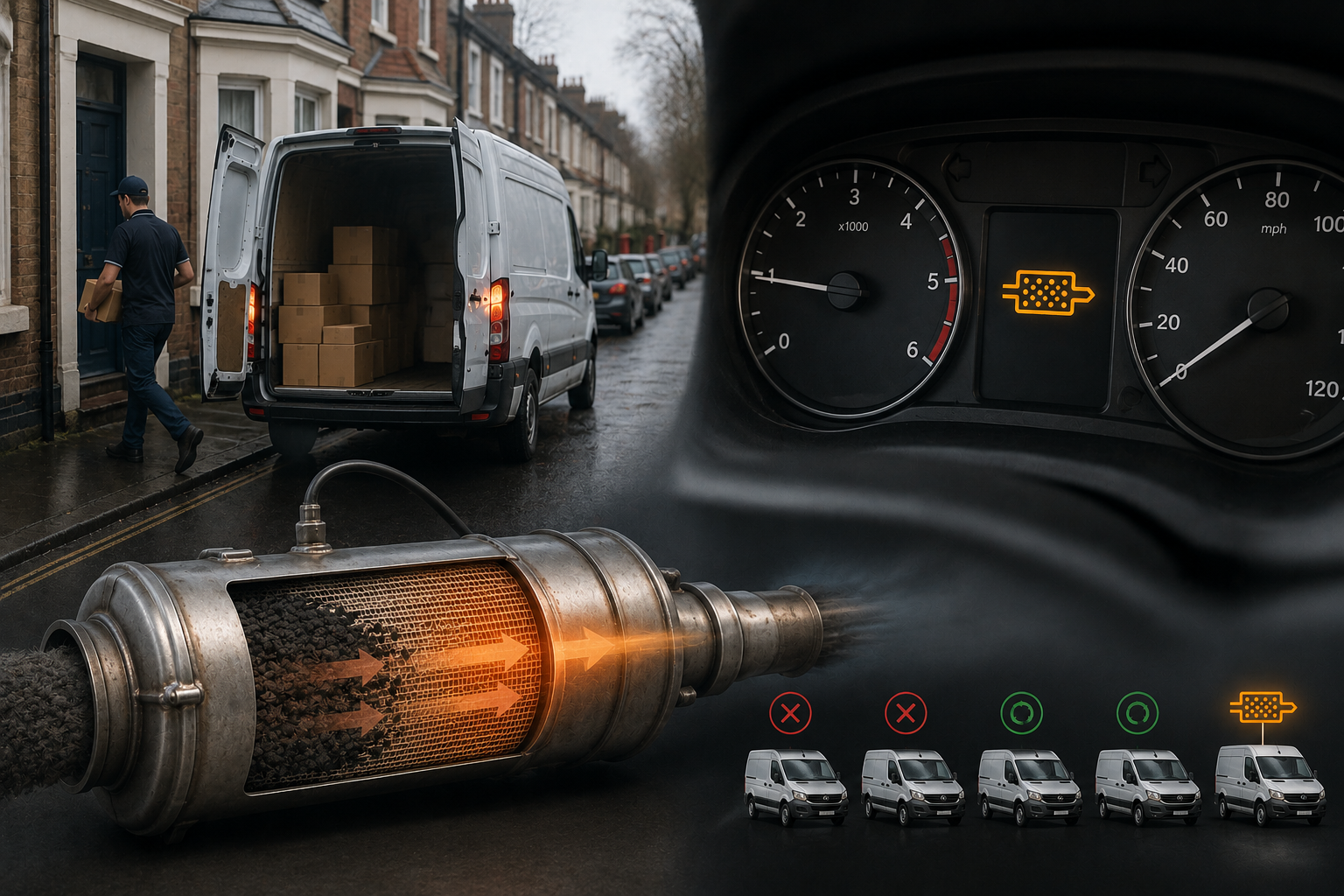
Short Journeys and Failed Regeneration
Active regeneration requires sustained heat. When drivers switch the engine off mid-cycle, regeneration fails and restarts later, causing repeated soot accumulation inside the DPF.
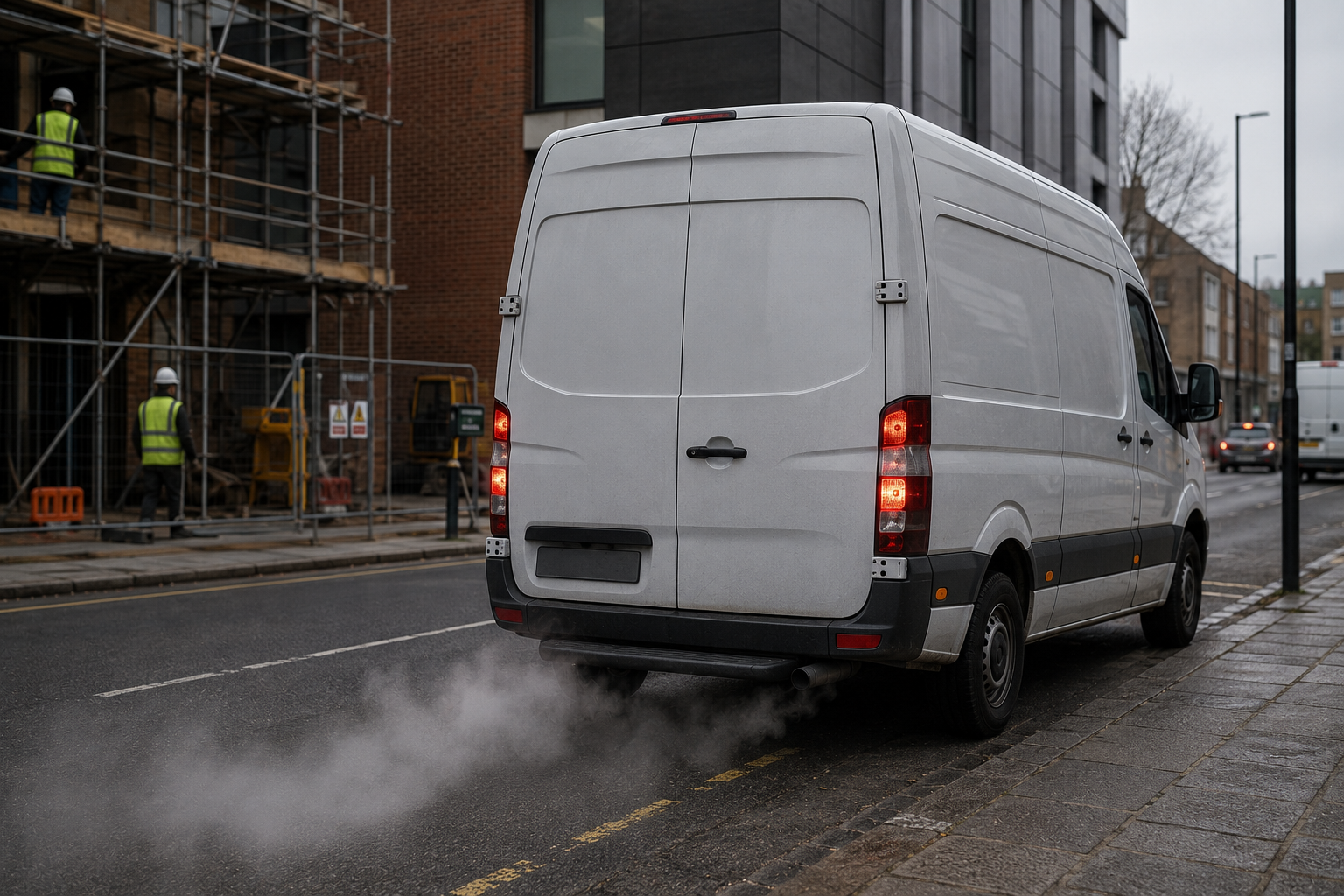
Excessive Engine Idling
Idling creates soot while keeping exhaust temperatures too low for regeneration. Over a working week, this quietly increases the risk of DPF blockage.
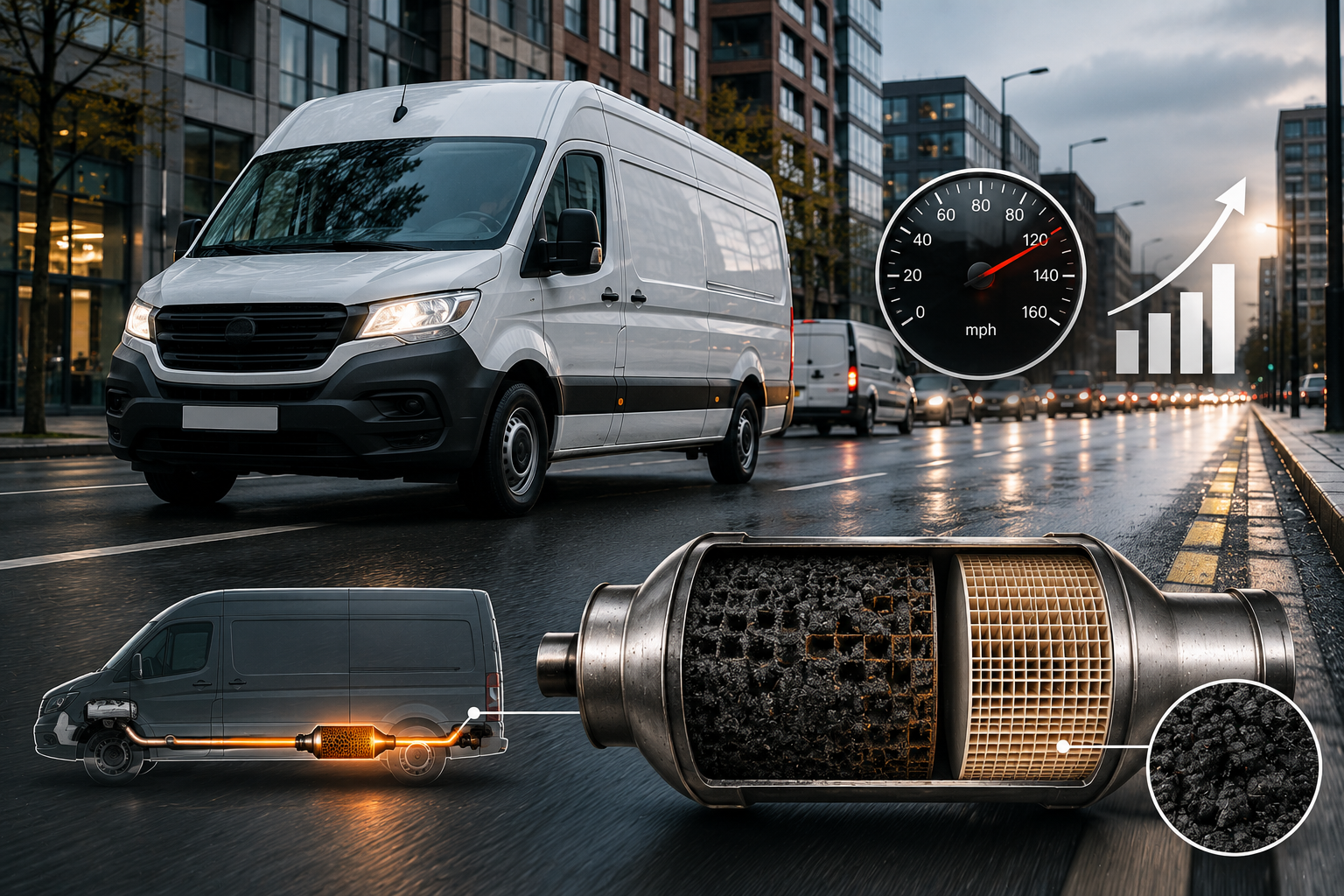
High Annual Mileage
High mileage on urban routes can cause more DPF problems than lower-mileage motorway use. Ash also builds up over time and reduces the filter’s overall capacity.
⚠ Fleet Manager Alert
If your drivers cover urban routes daily, your vans may not be completing DPF regeneration cycles. Schedule a diagnostic check before the warning light appears — not after.
Common Signs of a Blocked DPF in a Commercial Vehicle
Catching a blocked DPF early can make a real difference to repair costs, vehicle downtime and day-to-day fleet performance.
DPF Warning Light Illuminated
The clearest signal that something is wrong. Do not ignore it, and do not assume it will clear on its own.
Vehicle Enters Limp Mode
Power is deliberately restricted by the ECU to prevent further damage. A van in limp mode is almost unusable for daily work.
Noticeably Higher Fuel Consumption
A restricted filter forces the engine to work harder to expel exhaust gases, which can increase fuel usage.
White or Black Smoke From the Exhaust
This is often more noticeable during cold starts, after extended idling or when regeneration attempts fail.
Rough Idle or Sluggish Throttle Response
Back-pressure from a blocked filter can disrupt combustion efficiency and make the vehicle feel slow or uneven.
Strong Smell of Unburnt Diesel
This can become noticeable inside the cab, especially during repeated failed regeneration attempts.
Several Symptoms Together Need Urgent Attention
Any one of these symptoms warrants a diagnostic check. Several together mean the vehicle should be booked in without delay.
The Real Cost of DPF Problems for Fleet Businesses
Commercial vehicle downtime costs far more than the repair itself. Lost productivity, missed customer commitments and replacement vehicle expenses can quickly turn a simple DPF issue into a serious operational problem.
Vehicle Downtime Costs Money
A van waiting for a DPF replacement can be off the road for days. During that time, deliveries are delayed, jobs are missed and revenue opportunities disappear.
Lost Productivity Across The Fleet
For a fleet operator managing multiple vehicles, recurring DPF faults can create scheduling issues, staffing disruption and ongoing operational inefficiencies.
Replacement Vehicle Expenses
Many businesses are forced to hire temporary vehicles while repairs are completed, creating additional costs that are rarely budgeted for.
ℹ️ MOT Compliance Note
Since May 2018, UK MOT testers are required to visually inspect the DPF and check for evidence of removal or tampering. A blocked DPF is a manageable problem. A deleted DPF is both an MOT failure and a potential legal risk.
DPF Cleaning vs DPF Replacement
The most common misconception we encounter from fleet managers is that a blocked DPF automatically means replacement. In the vast majority of cases, that simply is not true.
Professional DPF cleaning — using specialist ultrasonic or pneumatic equipment — physically removes the soot and ash built up inside the filter substrate. When carried out correctly, a cleaned filter performs as well as a new one, at a fraction of the disruption and inconvenience.
| Factor | Professional DPF Clean | DPF Replacement |
|---|---|---|
| Turnaround Time | Same day — 2 to 4 hours ✔ | 1 to 2 days minimum |
| Original Filter Kept | Yes — no parts swapped ✔ | No — new unit fitted |
| MOT Compliance | Restored ✔ | Restored ✔ |
| Disruption to Fleet | Minimal ✔ | Significant |
| Suitable For | Blocked / soot-loaded filter ✔ | Physically cracked or melted unit |
| Environmental Impact | Low — no landfill ✔ | Higher |
| Repeat Value | Preventive plan available ✔ | One-off fix only |
✔ Professional Cleaning
Professional DPF cleaning removes soot and ash from inside the filter substrate. For blocked or soot-loaded filters, this can restore performance while keeping downtime, disruption and cost much lower than replacement.
⚠ DPF Replacement
Fleet DPF cleaningReplacement is only genuinely necessary in specific cases, such as a physically cracked filter, a melted substrate caused by an overtemperature event, or contamination with engine coolant.
A Thorough Diagnostic Should Always Come First
Replacement is genuinely necessary only in specific circumstances: where the filter substrate is physically cracked, where it has been melted by an overtemperature event, or where it has been contaminated with engine coolant. A thorough diagnostic will confirm which situation you are dealing with before any recommendation is made.
How Fleet Operators Can Prevent Recurring DPF Problems
Reactive repairs are always more disruptive than preventive maintenance. With the right driving habits, servicing choices and diagnostic checks, fleet managers can reduce repeat DPF faults across their vehicles.
Introduce a Periodic Motorway Run
Where operationally possible, build a sustained higher-speed run into driver schedules once or twice a week. Even 20 minutes on a dual carriageway can help passive regeneration complete.
Train Drivers to Avoid Unnecessary Idling
Driver behaviour directly affects DPF health. A simple briefing on why idling is damaging can quickly change habits and reduce avoidable vehicle downtime.
Use the Correct Engine Oil
DPF-equipped diesel engines require low-ash oil, typically C1, C2 or C3 grade. Standard oil can produce more ash and accelerate filter loading.
Schedule Proactive DPF Checks
For high-frequency urban routes, periodic diagnostics can check soot loading, differential pressure and regeneration history before the issue becomes a breakdown.
What To Monitor
Soot loading, differential pressure, regeneration history, fault codes and driver route patterns should all be reviewed as part of a proactive DPF maintenance plan.
Fleet Diagnostic Programmes
Expert DPF Cleaning offers fleet diagnostic programmes designed around high-use commercial vehicles, helping operators spot problems early and reduce repeated DPF failures across the fleet.
Why Fleet DPF Cleaning Is More Cost-Effective Than Reactive Repairs
The economics of proactive fleet DPF cleaning are straightforward. A van that comes in for a planned clean based on mileage or route profile is back on the road the same day.
A van that arrives in limp mode with a severely blocked filter requires more intensive work and may need additional sensor or EGR checks — all of which take longer.
Why Choose Expert DPF Cleaning
We work with sole traders, small fleet operators and larger commercial vehicle fleets across the UK. DPF cleaning is not a sideline for us — it is all we do.
Full Diagnostic ScanBefore any work is carried out, the vehicle is checked properly.
Specialist EquipmentWe use professional equipment on every vehicle, not chemical additives alone.
Post-Clean Flow TestPost-clean flow testing and ECU reset are included as standard.
Mobile Fleet ServiceMobile service is available for fleet operators and those unable to travel.
All Makes & ModelsFord Transit, Mercedes Sprinter, VW Transporter, Peugeot Boxer, Iveco Daily and more.
Written Report ProvidedA clear written report is provided after every clean.
Fleet Maintenance ProgrammesScheduled visits, priority booking and volume arrangements are available.
Lower Reactive CostsManaged maintenance can reduce unplanned downtime, fuel waste and emergency call-outs.
Get Ahead of Recurring DPF Faults
If you manage a fleet and are dealing with recurring DPF faults, or you want to prevent the problem before it starts, get in touch with Expert DPF Cleaning to discuss a managed approach for your operation.
Discuss Fleet SupportFrequently Asked Questions
Clear answers for fleet managers, van owners and commercial vehicle operators dealing with recurring DPF problems.
Keeping Your Fleet Moving Starts With Prevention
The relationship between commercial vehicles and DPF problems is not bad luck — it is a predictable consequence of how these vehicles are used. Stop-start urban routes, short journeys, engine idling and high mileage on city roads all work against the conditions a DPF needs to stay healthy.
Fleet DPF cleaning is not simply a repair service. For businesses that depend on their vehicles staying on the road, it is a maintenance discipline that prevents far more expensive and disruptive outcomes further down the line.
At Expert DPF Cleaning, we work with fleet operators of all sizes — from a single Transit to a multi-vehicle commercial fleet. Every job starts with a thorough diagnostic. Every vehicle leaves with a verified clean and a full report.
If your vans are showing DPF warning lights, entering limp mode, or simply due a health check, contact us to discuss how we can support your fleet — and keep commercial vehicle downtime to a minimum.