
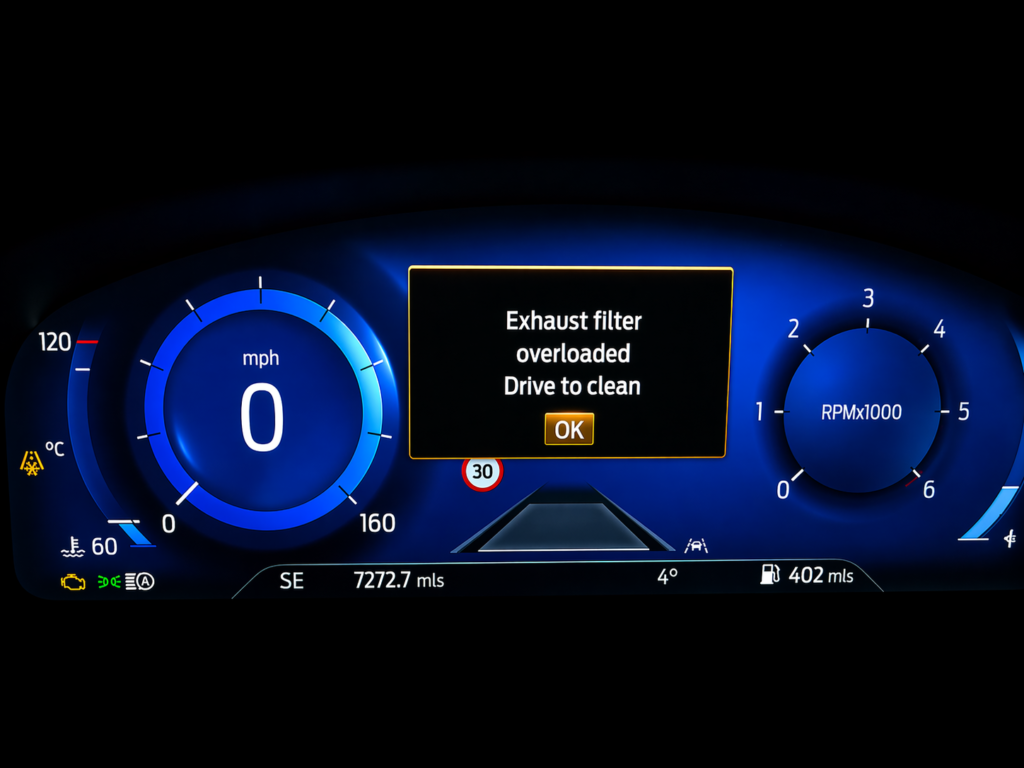


It starts with a light on the dashboard. Then a slight hesitation when you put your foot down. Then one morning, the van that pays your bills crawls out of your driveway at 30 mph and refuses to go faster
Sound familiar?
This is the Ford Transit DPF story — and it plays out thousands of times every year across Birmingham, the West Midlands, and the wider UK. Professional DPF cleaning is almost always the answer. The bad news is that most owners find out too late, after the damage is already done.
Here is what you actually need to know.
The Transit was not built for your commute
Britain loves the Ford Transit. Builders, couriers, tradesmen, caterers — if it needs shifting, a Transit shifts it. But here is the uncomfortable truth Ford does not put in the brochure.
The Transit’s diesel engine needs heat to stay healthy. Real heat. The kind that only comes from sustained driving at speed — not five trips to the depot and back, not school run traffic, not the Birmingham ring road crawl you do six days a week.
Every short journey deposits a little more soot into the Diesel Particulate Filter. On top of that, every cold start that never fully warms up adds another layer. Unlike a warning about low oil or an overheating engine, however, the DPF gives you almost no warning before things get serious.
By the time most Transit owners in Birmingham and across the West Midlands notice something is wrong, therefore, the filter is already in trouble — and DPF cleaning becomes urgent rather than routine.
What actually goes wrong — and why
The vaporiser nobody tells you about
Ask most mechanics about Transit DPF problems and they will mention soot, driving habits, and regeneration cycles. Ask a DPF cleaning specialist and they will immediately mention the vaporiser.
The Transit uses a fuel-burning vaporiser to raise exhaust temperatures during active regeneration. When this component fails — and it fails regularly — every regeneration attempt the van makes is completely pointless. The ECU triggers the cycle, the van tries to clean itself, and nothing happens. Soot keeps building — and as a result, the filter keeps blocking.
Many Transit owners across Birmingham spend money on forced regenerations that achieve nothing, simply because nobody checked the vaporiser first.
The wiring loom that nobody mentions either
There is a known wiring loom fault on the Transit that affects the exhaust temperature sensors. When it fails, the ECU loses accurate temperature readings and cannot manage the regeneration process properly. The DPF blocks, the warning light comes on, and the van goes into limp mode — but the real problem has nothing to do with the filter itself.
However, replace the DPF without fixing the loom and the new filter blocks within weeks. This is one of the most expensive mistakes Transit owners make — and one that proper DPF cleaning diagnostics would catch immediately.
The gear you drive in matters more than you think
This one surprises people. Cruising at 50 mph in 6th gear — perfectly legal, seemingly sensible — is one of the biggest causes of Transit DPF blockages across the UK. The engine is barely working. Exhaust temperatures stay low. The filter never gets hot enough to regenerate properly.
In contrast, drive the same route in a lower gear at higher revs and the DPF cleans itself. Yet nobody tells van drivers this at the point of sale.
The 97% blocked van with no fault codes
Owners report bringing their Transit in for a routine check only to discover the DPF is 97% blocked — with no fault codes stored and no dramatic warning signs beforehand. The van felt slightly sluggish. Fuel consumption crept up. Nothing that screamed emergency.
By this point DPF cleaning is urgent. Leave it any longer and the filter reaches the point where cleaning is no longer possible — and replacement becomes the only option.
What a neglected DPF does to your turbo
A blocked DPF does not just affect emissions. It creates backpressure in the exhaust system — and that backpressure goes straight into the turbocharger.
Every mile driven with a blocked DPF adds stress to the turbo bearings. On a Transit that spends its life under load carrying tools, materials, and stock around Birmingham and the West Midlands — that stress adds up quickly. Many owners discover they need a turbo replacement shortly after sorting the DPF, turning what should have been a straightforward DPF cleaning job into a far larger repair bill.
The coolant problem that looks like a DPF problem
A faulty coolant thermostat prevents the Transit’s engine from reaching proper operating temperature. A cold-running engine produces more soot. More soot means faster filter blockage. Consequently, more blockages trigger more forced regenerations. Over time, those repeated regeneration cycles degrade the engine oil significantly.
One small thermostat fault quietly destroys a DPF over months — and nobody connects the dots until the DPF cleaning specialist runs a full diagnostic.
The dashboard is speaking — here is the translation
Your Transit communicates DPF distress in a specific order. Learn to read it:
— Fuel consumption quietly increases on familiar routes — first sign, easy to miss
— DPF warning light appears — the filter needs a regeneration drive, do it now
— Engine management light joins the DPF light — a sensor or component fault is involved, book a DPF cleaning diagnostic immediately
— Power drops noticeably under load — soot loading is now serious
— Limp mode activates — the ECU has cut power to protect the engine, immediate DPF cleaning or inspection needed
— Black or grey smoke from the exhaust — the filter has stopped doing its job effectively
Each stage costs more to fix than the one before it. Most owners arrive at stage four or five. The ones who act at stage one or two spend the least.
DPF cleaning or replacement — the honest answer
Replacement is the outcome dealers often push for. It is also the most expensive outcome — and in most cases, completely unnecessary.
If the Transit’s DPF substrate is physically intact — no cracks, no melting, no oil contamination — professional DPF cleaning restores it to full working condition. The DPF cleaning cost is a fraction of what a replacement unit costs fitted. For Birmingham and West Midlands van owners keeping running costs tight, this matters.
Replacement only makes sense when the ceramic substrate inside the filter is physically damaged beyond recovery. A proper DPF cleaning specialist inspects and flow-tests the filter before making any recommendation. If cleaning works, that is what they do. If it does not, they tell you honestly.
What does not make sense, therefore, is replacing an expensive component without first diagnosing why it blocked — because without fixing the root cause, the new filter blocks in exactly the same way.
How does professional DPF cleaning work?
Good question — and one worth answering properly, because there is a significant difference between a genuine professional DPF clean and a quick spray with a bottle of additive.
Step 1 — Diagnostic first, always
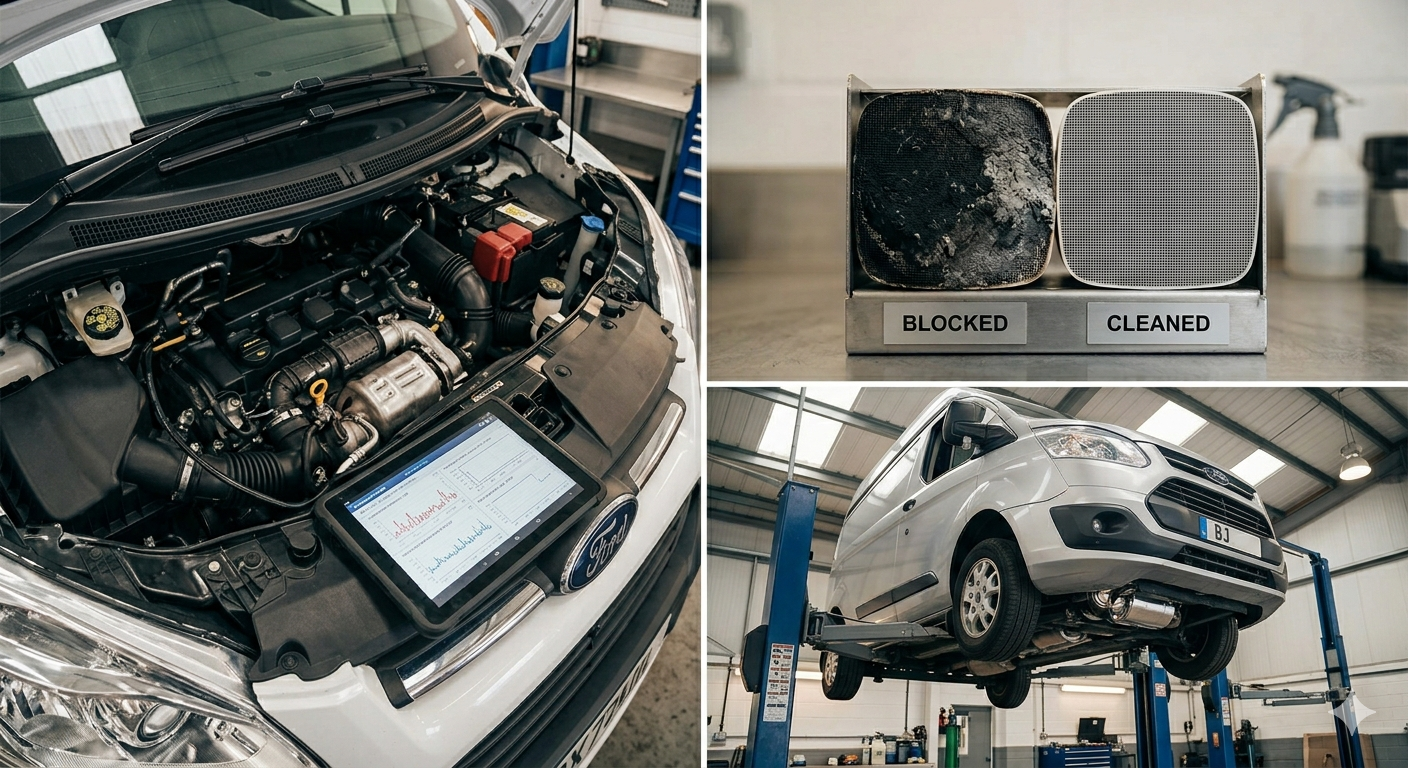
Before anything is cleaned, the technician reads live data — not just fault codes. Soot percentage, backpressure readings, temperature sensor values, vaporiser function, glow plug condition. On the Transit this step is non-negotiable. As a result, the root cause gets identified before the filter gets touched.
Step 2 — Forced regeneration for moderate blockages
Where soot loading allows it, a controlled forced regeneration burns off the accumulation using specialist diagnostic equipment. Proper temperature management throughout the process prevents filter damage.
Step 3 — Ultrasonic cleaning for heavy blockages
The technician removes the DPF and subjects it to ultrasonic cleaning. High-frequency sound waves dislodge compacted ash and soot from deep inside the ceramic channels — material that regeneration physically cannot remove. This is the only method that genuinely restores a heavily blocked filter.
Step 4 — Flow test before and after
The technician measures backpressure before cleaning and again after. In this way, the numbers prove the filter works — not just an assumption based on appearance.
Step 5 — ECU reset
The technician resets the DPF soot counter in the ECU using specialist software. Skip this step and the Transit continues behaving as though the filter is blocked, even after a perfect clean DPF service.