
Why They Happen & How to Clean DPF the Right Way
The Audi A3 2.0 TDI is one of the UK’s most popular diesel hatchbacks — refined, efficient, and genuinely fun to drive. But there’s one weak spot that catches thousands of owners off guard every year: the Diesel Particulate Filter. Here’s everything you need to know.

Why the Audi A3 2.0 TDI is particularly vulnerable?
The 2.0 TDI engine — found across the A3, Golf, Leon, and Octavia platforms — is brilliant on a motorway. But the reality for most UK owners is very different. Short school runs, commutes stuck in traffic, and weekend town trips all add up to one thing: a DPF that never gets hot enough to clean itself.
Unlike larger diesels that spend more time at motorway speeds, the Audi A3 2.0 TDI in typical UK use spends the majority of its life below the exhaust temperatures needed for passive regeneration. The result? Soot builds up faster than it burns off — and the problems start. This is precisely why DPF cleaning diesel vehicles like the A3 is one of the most requested services across the UK.
The 6 most common Audi A3 2.0 TDI DPF problems
01
Warning light that won’t clear
The most reported issue. The orange DPF light comes on and stays on, even after a motorway run. This means soot loading is too high for passive regeneration to work alone — a professional clean DPF service is needed.
02
Limp mode activation
When the DPF reaches critical blockage levels, the ECU cuts power to protect the engine. The A3 crawls — often limited to 30–40 mph — until the filter is properly cleaned.
03
Turbocharger damage
A blocked DPF creates excessive exhaust backpressure that strains the turbo bearings. Many A3 2.0 TDI owners find they need a turbo replacement shortly after ignoring a DPF warning — a bill that dwarfs the DPF cleaning cost entirely.
04
Faulty differential pressure sensor
The sensor that measures DPF blockage is a known weak point on the 2.0 TDI. When it fails, the ECU gets false readings — either triggering unnecessary warnings or missing a genuine blockage entirely.
05
Failed or interrupted regeneration
The A3’s active regeneration takes 25–35 minutes of continuous driving to complete. Switch the engine off mid-cycle and the soot stays put — accumulating with every journey until a full clean DPF procedure is the only option.
06
MOT failure on emissions
A partially or fully blocked DPF causes visible exhaust smoke and elevated particulate emissions — both automatic MOT failures. Since 2014, UK MOT tests include mandatory DPF checks.
Worth knowing: The earlier PD (Pumpe Düse) 2.0 TDI engines were more DPF-prone than the later Common Rail (CR) units introduced around 2008. If your A3 is a 2008 or newer model with the CR engine, it handles regeneration better — but short-journey driving will still clog it eventually.
Symptoms to watch for in your Audi A3
The A3 2.0 TDI gives you clear signals when the DPF is struggling. Don’t dismiss these as minor — each one that appears alongside another doubles the urgency:
- DPF or engine management light on
- Noticeable loss of power or acceleration
- Vehicle enters limp mode
- Fuel consumption increases suddenly
- Black or grey smoke from exhaust
- Rough idle or engine hesitation
- Unusual smell from the exhaust
- Repeated failed regeneration attempts

Replace or clean DPF? The honest answer for A3 owners
Audi dealers will often quote a significant sum for a new OEM DPF on the A3 2.0 TDI. Before you accept that, it’s worth knowing that in the majority of cases, the existing filter is fully salvageable. Understanding the DPF cleaning cost versus replacement cost is key to making the right decision.
DPF replacement
Only necessary if the filter substrate is physically cracked, melted, or oil-contaminated. Overkill for a standard soot blockage — and the most expensive outcome by far.
Professional clean DPF service
Removes soot and ash, restores full exhaust flow, includes ECU recalibration and before/after flow test proof. The smart first step for any A3 DPF issue.
The key question is whether the ceramic substrate inside the filter is physically intact. If it is — and in most blockage cases it will be — professional DPF cleaning diesel vehicles like the A3 delivers the same result as a new filter without the replacement price tag.
How does professional DPF cleaning work?
This is the question most A3 owners ask once they’ve decided to clean DPF rather than replace it. Here’s exactly what happens during a professional DPF cleaning diesel service:
- Diagnostic scan first Fault codes are read, soot percentage is measured, and backpressure is tested. The root cause — sensor fault, driving habits, injector issue — is identified before anything else is touched.
- Forced regeneration (moderate blockages) For A3s with manageable soot loading, a controlled forced regeneration using specialist diagnostic equipment burns off the accumulation without removing the filter from the car.
- Off-car ultrasonic cleaning (heavy blockages) The DPF is removed and ultrasonically cleaned — high-frequency waves dislodge compacted ash and soot from the ceramic channels that regeneration simply cannot reach.
- Flow test verification Backpressure is measured before and after cleaning. You receive the actual results — proof the filter is restored, not just a verbal assurance.
- ECU reset and recalibration The DPF soot counter in the A3’s ECU is reset using specialist software. Without this step, the warning light stays on and the car behaves as if the filter is still blocked — even after a perfect clean.
One important note for A3 owners: if the DPF was blocked because of a faulty pressure sensor or a failing injector, that underlying issue must be fixed before cleaning. Otherwise, the filter will block again within weeks. A proper diagnostic before any clean DPF work is non-negotiable.
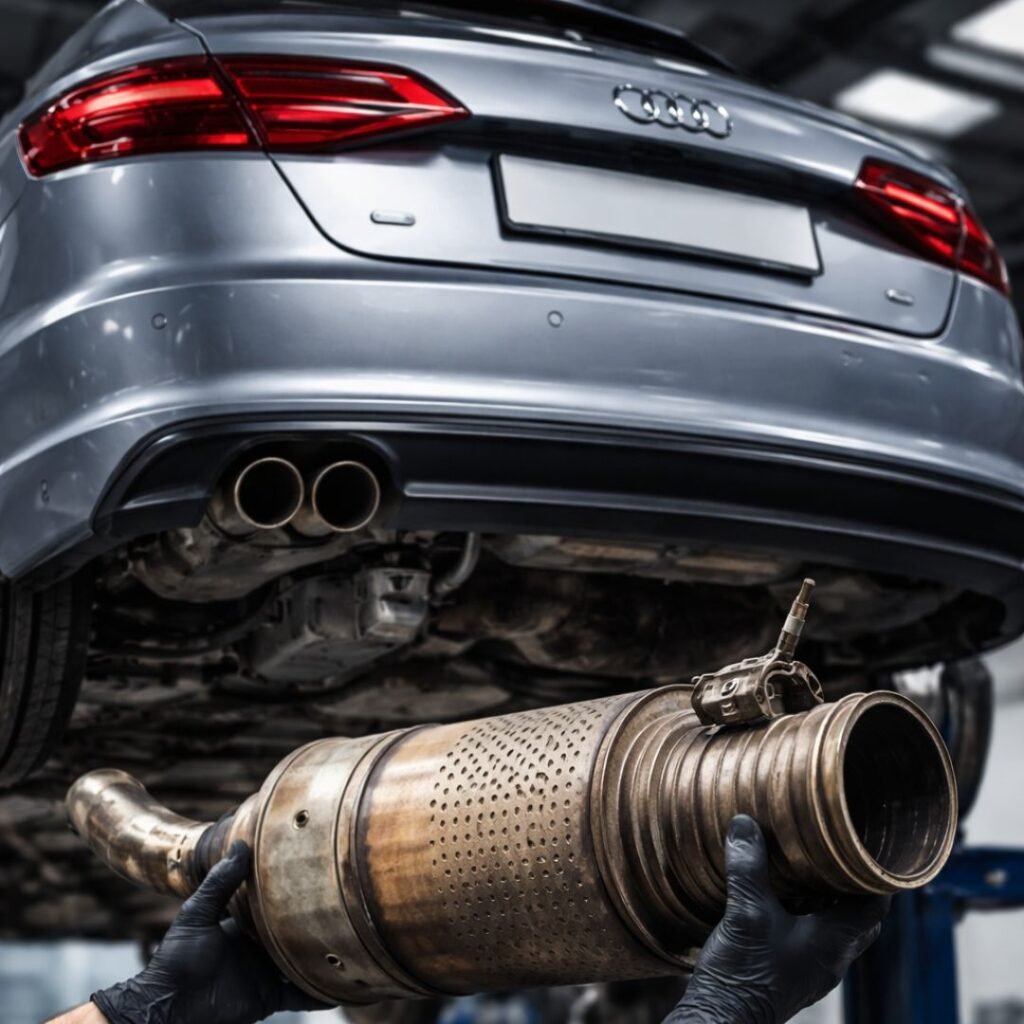
Preventing DPF problems in your Audi A3 2.0 TDI
Motorway run every two weeks — 20–30 minutes at 60–70 mph gives the DPF the sustained heat it needs for passive regeneration. Essential for urban drivers.
Never switch off during active regeneration — If the DPF light flickers and the revs feel slightly higher than usual, the car is regenerating. Let it finish before switching off.
Use the correct engine oil — The 2.0 TDI requires a low-SAPS, low-ash oil (typically 5W-30 VW 507.00 spec). The wrong oil accelerates ash build-up inside the filter.
Service on schedule — Worn injectors produce more soot, overwhelming the DPF faster. Keeping on top of A3 service intervals directly protects the filter.
Act on warning lights immediately — A DPF light caught early keeps DPF cleaning cost low. Left too long, it means limp mode, turbo strain, and a far bigger bill.